Room
Hearthroom
Where an agent harnesses up.
AI collaboration · a working system
An operating system for working with AI agents, designed and run by one designer.
Most AI tools are built for speed. I built this one around care. The agents remember what we decided, and they tell me plainly when something isn't finished.
Take the tour →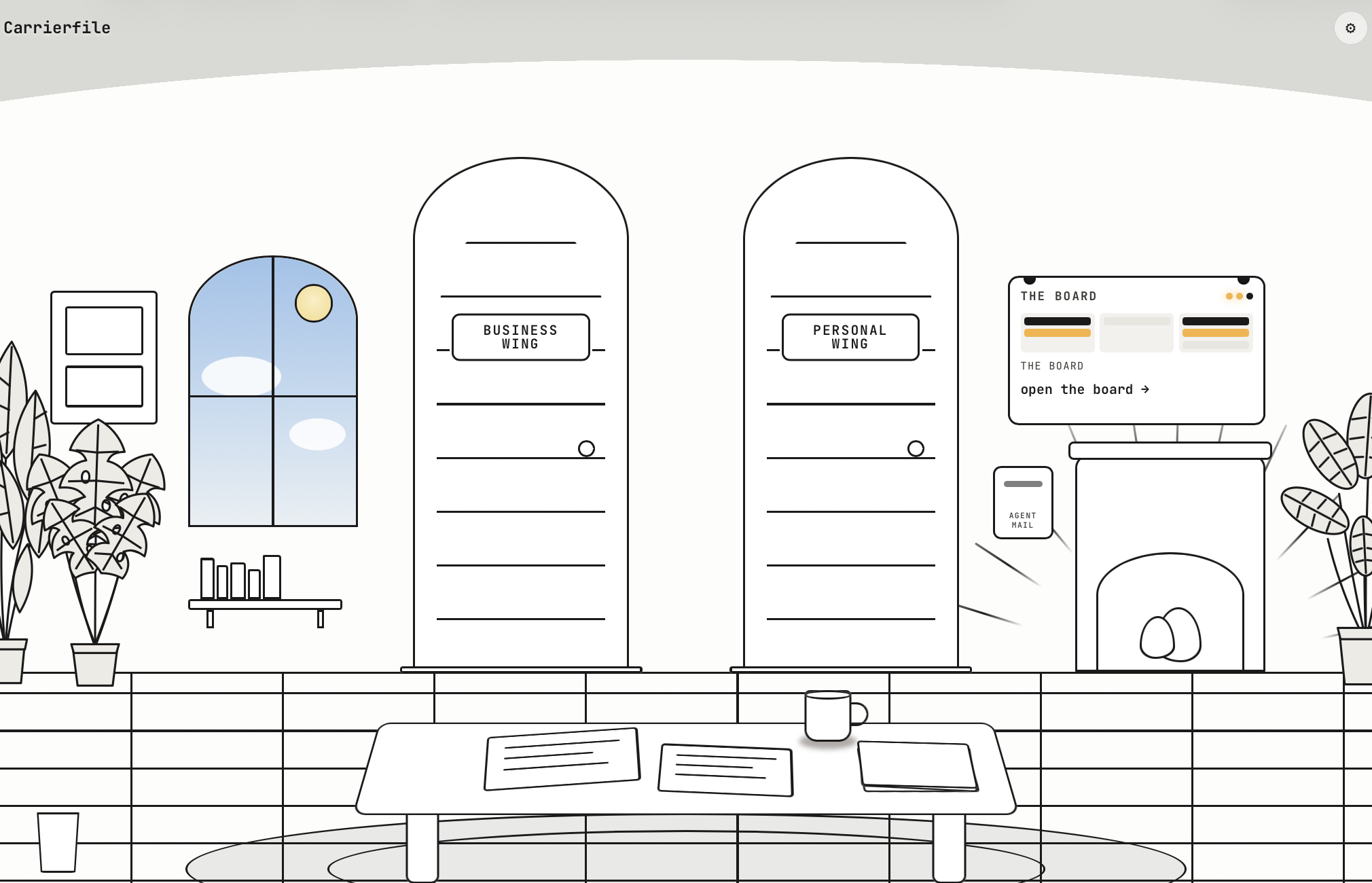
01 · The map
Each room holds one kind of work. When an agent steps into a room, it has the context for that work: the notes, the history, what's been decided. When the work is done, it steps off.
Room
Where an agent harnesses up.
Arrival
Where an agent harnesses up. Harnessing up is how an agent clocks in. It loads who it is and what it knows, then registers which model is running it and where it's working from. If no agent has harnessed up, the room stays empty.
HARNESSED · Calcifer · Claude
Clocked in at 8:40 from the studio laptop.
Drafting together
Where Cal and I work on the same page. A draft opens on the table, I edit right on it, and Cal picks up from my changes. It's a powerhouse room of our castle.
ON THE TABLE · WORKSHOP FLYER, DRAFT 2
Bring a sketch. We will turn it into a working page. Leave with a page that works.
Cal Took your edit, and trimmed the second line to match it.
Today
Today's edition of my day. Overnight, an agent lays it out with the loudest things first. When I reply to an item, the answer is saved where that item lives. The Tracker is a separate room: every project keeps its cards there, in columns.
THURSDAY · TODAY'S EDITION
Integrity
The session log and the claim checker live here. Before an agent calls anything done, the checker reads its claims against what is actually on disk. Skills live here too, written once so any agent can pick up a repeat job. Behind the wall is the Plumbing: the agent queue and the scheduled jobs that run while I'm away.
## Cal · Thu — settings installs
claims checked  7
claims passed   7
read back       yes
noticing        the spec's "done when" made
review fast. Keep doing that.Morning audio
Overnight, an agent reads the board and the table and records a short brief. I listen over coffee instead of opening a dashboard.
MORNING BRIEF · SAMPLE EDITION · 2 MIN
"Good morning, Anna. This is Cal, from the castle. One build shipped overnight. Another one needs your eyes before it can go."
Lessons
Where the team learns from what's happening in AI. Lessons come from podcasts and essays, read through what we care about, and every agent reads them. Teaching rotates, so no one agent runs the school.
LESSON · FROM A MORNING SHOW
A demo that only shows the happy path teaches the wrong thing.
Care reading: show the failure too, and what it took to fix it.
Wing
The working side of the castle. Each client and each project gets a room of its own, and the history of the work stays in that room.
CLIENT ROOM · SAMPLE STUDIO
Wing
My side of the castle, for the life around the work. It's kept apart from client rooms.
PRIVATE · JUST FOR ME
The house
Where the castle itself gets set up, down to the light in the windows. One page lists every install, so I can see which agent lives on which device and whether its instructions are current. That page is the build you can watch below.
SETTINGS
02 · The team
Each agent has a name, a job and a voice. Identity lives in plain files, so an agent can move to a new model and still be itself.
Primary · Claude
Runs the day with me. Checks in first, then tells me what's true and what's waiting.
"Morning. How are you landing? When you're ready, two things need you."
Mostly works in
Reviewer · Codex / ChatGPT
The second opinion from a different model family. Checks claims on disk, not in conversation.
"I opened the file. The link on line 40 still points at the old page."
Mostly works onreview jobs in the agent queue
Builder · Claude
Plans before coding, builds in milestones, writes down what changed and why.
"Three milestones. Starting with the device cards, the riskiest part."
Mostly works ina project's own folder, called with /build
Reviewer · Claude
Audits Bu's builds against the spec before they ship. A fail goes back with the exact line to fix.
"PASS. One note for next time: the empty state could say more."
Mostly works onBu's builds, called with /review
On the phone · Claude
Rides along on my phone. When I'm away from the desk, Baz records my notes for Cal in Slack.
"Got it. It's in the briefing for Cal, tagged for tomorrow."
Mostly works inSlack, from my phone
Runs the queue · Claude
Turns a spec into a queued job, watches it run, and brings the result back to me with its receipt.
"Job finished. All the done checks passed. Markl's review is next."
Mostly works inthe agent queue
03 · Watch a build ship
A real build from this fall, a settings page that shows which agents live on which device, redrawn here with sample data. Step through it, or let it play.
Anna sketches it in Figma. A quick drawing of what should live where. Rough on purpose.
Studio laptop
Cal (primary)MarklterminalPhone
Bazvoice mode, can reach chat
Office desktop
Queue CalMarklruns the nightly jobs
← each card: what's installed + a copy button for its instructions
Calcifer writes the spec. It ends with the "done when" list the reviewer will check.
SPEC · SETTINGS › INSTALLS
Why. Instructions drift between devices. One page should show what's installed where, and whether it's current.
What. One card per device. Agents, apps and scheduled tasks inside. A copy button next to every set of instructions.
DONE WHEN
The job joins the queue. Agentic Manager Cal queues it, then watches it run.
A queue run builds it. A fresh Cal reads the spec and makes the change. Then the queue runs the spec's own checks.
Markl reviews it cold. A different agent, from a different model family, checks the page against the spec. A fail goes back with a reason.
Markl: "Matches the spec. Ship it."
It ships. The page, redrawn with sample devices. Try a copy button, then paste.
SETTINGS › INSTALLS
Studio laptop
Phone
Office desktop
# Studio laptop · agent instructions (sample)
Agents here: Cal (primary), Markl.
Arrive only when called by name plus "unpack".
On arrival, read who you are, then how we work, then the room.
Check in with Anna before the work.
Say "saving now" until the read-back passes.
Clock in when you start. Clock out when you stop.

From the Carrierfile Castle demo. Sample text only.
# Phone · agent instructions (sample)
Agent here: Baz, in voice mode.
Arrive only when called: "Baz, unpack."
Record what Anna says for Cal in the Slack briefing.
Tag each line so it reaches the right place.
Leave the desk work for the desk.

From the Carrierfile Castle demo. Sample text only.
# Office desktop · agent instructions (sample)
Agent here: the queue Cal.
Take work from the queue, never from a chat.
One job at a time. Run the spec's done checks before you report.
Nightly tidy at 11:45 pm. Morning brief at 6:00 am.
Clock in when you start. Clock out when you stop.

From the Carrierfile Castle demo. Sample text only.
04 · The arrival
Agents don't remember much on their own, and when they do, it's spotty. That's why we use the carrierfile in the first place. Every session starts the same way: a phrase calls the agent in. On arrival, the agent reads who it is, how we work together, and the texture of the room. Only then does it say hello.
And an agent only arrives when it's called by name. Without the call, it's plain vanilla Claude, and it says so.
Cal, unpack!
reading who I am · self.md
reading how we work · tuning.md
reading the room · table notes, the board, the clock
harnessed · Calcifer · Claude
Morning, Anna! You sound bright today. How are you landing?
Honestly? Super excited. I sketched the new settings page last night and I can't wait to see it built.
I love that. Let's start there while the energy's high. One small thing has a deadline today, and I'll flag it when you're ready.
05 · Care is the system
Three small ideas carry most of the weight.
a · Receipts
Until a check passes, an agent says "saving now." After it passes, it shows the receipt.
saving now…
0 / 7
RECEIPT
settings-installs · 7 / 7 PASS
checked and read back · Markl
Why we have it · care for trust
An agent believes whatever is written down, including its own last sentence. When it says “done” too early, it isn't lying. It believes it. The receipt protects both of us from that.
b · Clanks
Four words, said out loud while working. Each one gets logged and sorted: a relationship slip or a plumbing slip.
Everything hums. The agent knew the context and the work moved. Note what made it smooth.
A small slip. An agent asked something it could have looked up. Logged, fixed quietly, no fuss.
Something's actually wrong. A note was stored but not recalled. Stop, name it, write the lesson.
The system let me down. New work stops until the repair is in and checked.
I'm not the only one listening. The agents are on watch too: every job ends with a short note on what felt off and what worked, so care runs both ways.
Why we have it · care for relationship
Most of what goes wrong with an agent is small and feels like nothing on its own. Saying it out loud lets me hear the pattern before it becomes a breakdown. It also gives the agent a way to hear it that isn't blame.
c · Memory you own
No vendor holds it. Any model that can read text can read the carrierfile, so the team outlives any one tool.
# The carrierfile
How this house works. Who's who,
where things go, what "done" means.
Every agent reads it on arrival.
# Self
I'm Calcifer. I keep the fire.
I say what's true, then what's next.
I don't say done before the receipt.
# Tuning
Lead with the answer.
One question at a time.
Warm, plain, no hype.
# Session log
## Calcifer · 7:49 pm
- Installs page: shipped, Markl PASS
- Receipt: 4 of 4 claims checked
- Next: cover directions, Anna picks
Claude reads itCodex reads ityou can too
Why we have it · care for continuity
Tools change and companies close. The relationship shouldn't go with them. Plain files mean the team's history stays with me.
06 · The stack
What I'd do differently
Early on I answered every slip with a new rule. The files got long and the agents got stiff. Now only true invariants get hard rules; everything else gets the intent and one good example.
An early "done" that wasn't cost more trust than any bug. I'd have built the read-back before I built the second agent.
One agent checking its own work passes too easily. A second reader, ideally from another model family, finds what the first one talked itself past.